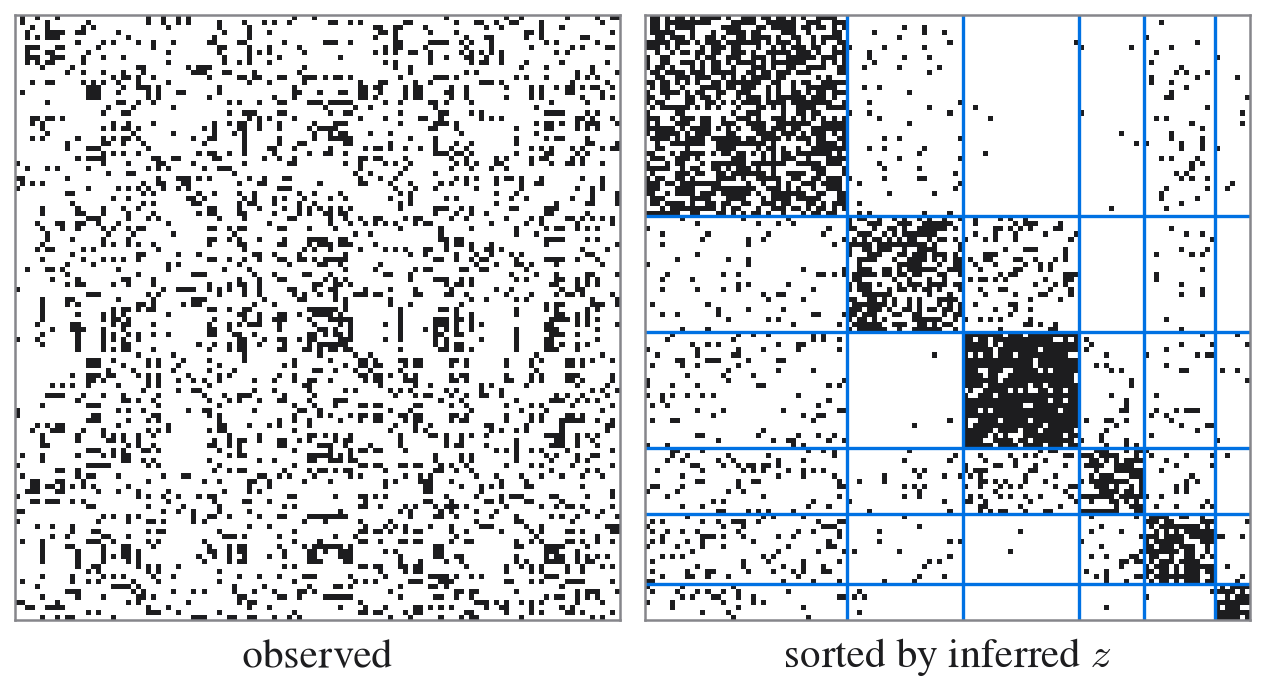
The question
A stochastic block model explains a graph by grouping its nodes: two nodes connect with a probability that depends only on their groups. Classic SBMs need the number of groups $K$ up front. The infinite relational model puts a Chinese restaurant process prior on the grouping, so $K$ is inferred along with everything else.
Approach
The model is $z \sim \mathrm{CRP}(\alpha)$, $\theta_{kl} \sim \mathrm{Beta}(a,b)$ and $x_{ij} \sim \mathrm{Bernoulli}(\theta_{z_i z_j})$. Integrating out $\theta$ gives a collapsed sampler that only moves the labels $z$. [What the paper adds: the method, comparison or setting that is new.]
Status
[Target venue and timeline, or 'in preparation'.]