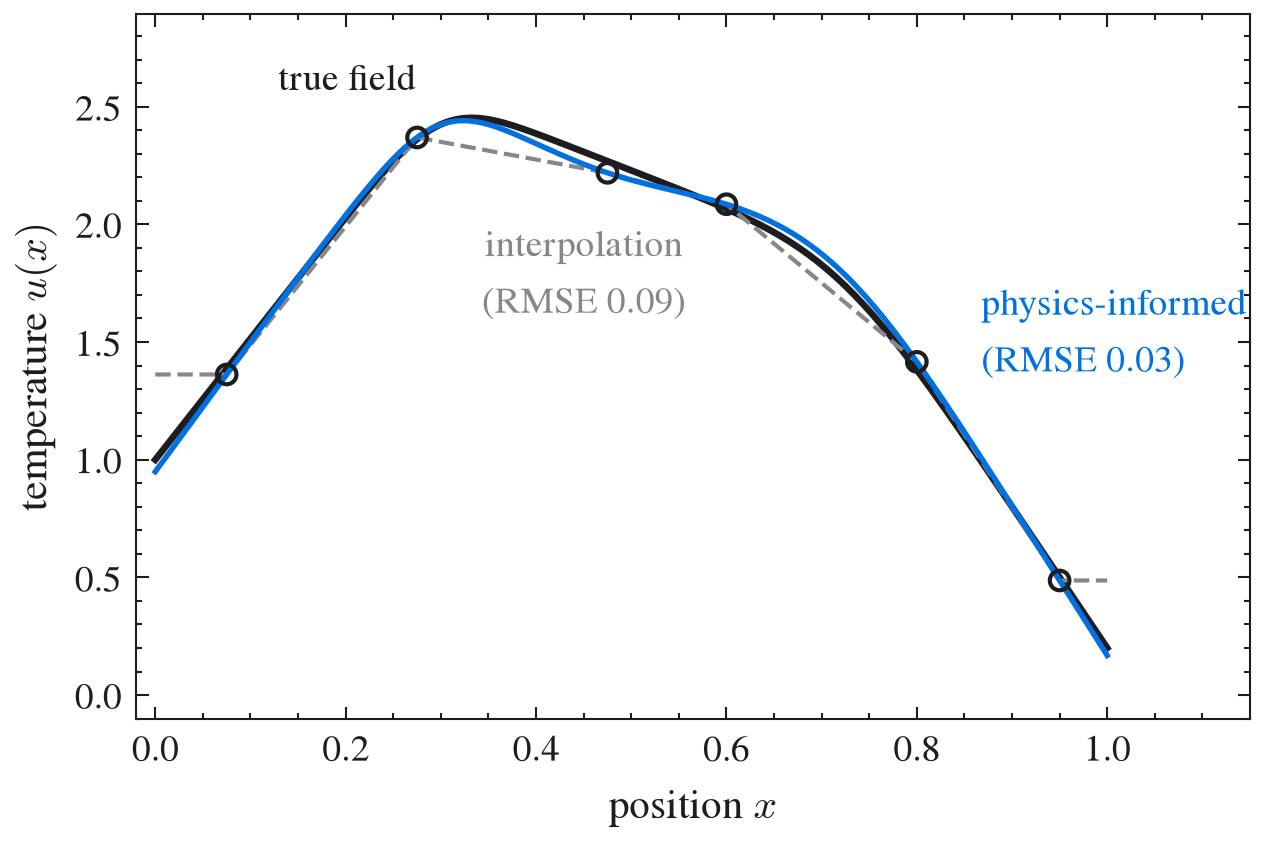
Why put physics in the model
Data from the real world is scarce and noisy, but the laws it obeys are often known. Physics-informed models use that: they penalise the residual of a governing equation (physics-informed neural networks), learn the solution operator of a whole family of equations (neural operators), or differentiate through a simulator.
Digital twins
A digital twin is a simulation kept in sync with a real system through measurements. Physics-informed ML makes twins fast enough to run alongside the real thing, and trustworthy where measurements are thin.
Where this is heading
Pasteur Labs builds what it calls simulation intelligence: AI, differentiable physics and scientific computing in one platform. The Aurelia Institute designs habitats for space, such as its self-assembling TESSERAE structures, where full-scale testing on Earth is hard and design leans on models. That is the kind of problem I want to work on.
What I'm doing
[e.g. the FNO surrogate tutorial you're working through, and what you found.]
References
- M. Raissi, P. Perdikaris and G. E. Karniadakis. Physics-informed neural networks. Journal of Computational Physics 378, 686–707, 2019.
- G. E. Karniadakis et al. Physics-informed machine learning. Nature Reviews Physics 3, 422–440, 2021.
- Z. Li et al. Fourier neural operator for parametric partial differential equations. ICLR, 2021.
- A. Lavin et al. Simulation intelligence: towards a new generation of scientific methods. arXiv:2112.03235, 2021.